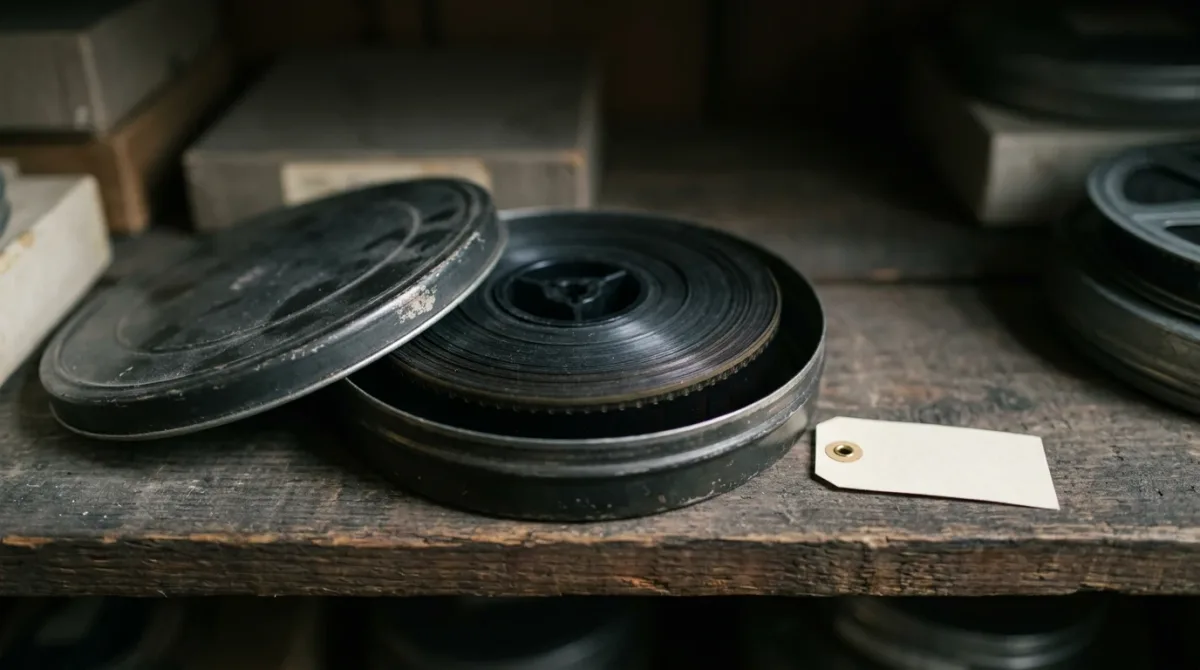
The National Film Registry is a list, not a prize. Once a year the Librarian of Congress names up to 25 motion pictures deemed "culturally, historically or aesthetically significant" and marks them for long-term preservation. Films must be at least 10 years old to be eligible. The 2025 class, announced January 29, 2026, brought the registry to 925 titles.
That is the whole mechanism in outline, and it is worth understanding because the registry is regularly misread as a canon, an award, or a promise that a film has been rescued. It is closer to a preservation priority list assembled with public input, and the rules governing it have been fixed by statute since 1988.
What is the National Film Registry, exactly?
It is the annual selection list maintained by the Library of Congress under the National Film Preservation Act. Congress passed the original act in 1988 as Public Law 100-446, creating the National Film Preservation Board and directing the Library to identify American films worth preserving.
The Library describes the Board's job as ensuring "the survival, conservation and increased public availability of America's film heritage." The registry is the visible end of that work: a running inventory of titles the Library has formally designated as worth keeping, film by film, year by year.
The authorizing legislation has never been permanent. According to the Library of Congress, Congress reauthorized the program in 1992 (Public Law 102-307), again in 1996 (Public Law 104-285), in 2005 (Public Law 109-009), in 2009 (Public Law 110-336), and in 2016 (Public Law 114-217), the last of these for ten years.
Who decides which films get in?
The Librarian of Congress makes the final call. The National Film Preservation Board reviews nominations, debates candidates and votes, then forwards recommendations; the Librarian selects the annual class after consulting Board members and Library specialists. The Board advises. It does not choose.
The Board itself is not a small committee of critics. The Library puts its membership at 44 members and alternates drawn from "the film industry, archives, scholars, filmmakers and others who comprise the diverse American motion picture community" — guilds, studios, archives and academics, rather than a panel assembled by taste.
The statutory phrase that governs everything is short: a film must be "culturally, historically or aesthetically significant." Any one of the three is enough. That is why a class can hold a studio blockbuster, a 1910s two-reeler and a documentary at the same time without contradiction.
Can any film qualify, or only Hollywood features?
Any American film at least 10 years old can qualify. The Library states plainly that selections need not be feature-length and need not have received a theatrical release, and that the legislation calls for "the broadest possible range of films" to be considered for eligibility.
The 2025 class shows what that looks like in practice. Alongside Inception (2010), Clueless (1995), The Thing (1982) and The Incredibles (2004), the Library named The Tramp and the Dog (1896), The Oath of the Sword (1914) and The Maid of McMillan (1916) — three titles from the first decades of American filmmaking.
The same class included the documentaries Brooklyn Bridge (1981), Say Amen, Somebody (1982), The Wrecking Crew (2008) and The Loving Story (2011), plus Ten Nights in a Barroom (1926) and Sparrows (1926) from the silent era. Nothing about the mix is accidental; the eligibility rules are written to produce exactly that spread.
How does the public nomination process work?
Anyone can nominate. The Library opens public nominations each year and counts them: 6,744 titles were submitted for the 2024 class, and 7,559 for the 2025 class. Nominations for the following year's registry are accepted through August 15, according to the Library's announcement.
Public input is not purely advisory. The Library's announcement of the 2025 class states that the film receiving the most public votes is automatically added to that year's selections. Everything else in the class goes through the Board-and-Librarian route described above.
That single automatic slot is the only place where raw public volume translates directly into a selection. It also explains why campaigns for particular titles circulate online each summer — the deadline is real, and the top vote-getter's place is guaranteed rather than merely considered.
What actually happens to a film after it is named?
Designation is the beginning of preservation work, not proof it has been completed. The Library says it works to ensure selected films are preserved through the copyright holders, the filmmakers, other archives, or its own National Audio-Visual Conservation Center at the Packard Campus in Culpeper, Virginia.
This is the most common misunderstanding about the registry. Naming a film does not automatically mean the Library holds a pristine copy of it, nor does it transfer any rights, nor does it place the film anywhere a viewer can immediately watch it. It commits institutional attention to the surviving material.
For a recent studio release, that attention is largely insurance against future format decay. For a 1914 short, it can mean the difference between a print that gets copied and catalogued and one that quietly deteriorates in a vault.
Why does a preservation list matter for what is watchable at all?
Because the American silent era is mostly gone. In a 2013 study published by the Council on Library and Information Resources and the Library of Congress, David Pierce found that only 14% of American silent feature films from 1912 to 1929 survive as originally released in complete 35mm copies.
The rest of Pierce's accounting is equally blunt. His figures cover 10,919 titles.
| Survival status of American silent features, 1912-1929 | Titles | Share |
|---|---|---|
| Complete, as originally released, in 35mm | 1,575 | 14% |
| Complete, but in foreign-release or small-gauge editions such as 16mm | 1,174 | 11% |
| Incomplete, missing at least one reel | 562 | 5% |
| Believed lost | — | 70% |
Source: David Pierce, The Survival of American Silent Feature Films: 1912-1929, Council on Library and Information Resources and the Library of Congress, September 2013.
Estimates of the wider loss run higher still. Patrick Loughney, then head of the Library's Packard Campus, told NPR in 2011 that roughly 80% of silent films made between 1890 and 1930 are gone, and described the return of some 194 American titles that had survived in a Russian archive because, as he put it, "over 1,300 American feature films were actually shown and distributed in Russia during that era."
Read against those numbers, the registry stops looking like a ranking. It is a yearly attempt to decide, out of a national film output that has already lost most of its first three decades, which surviving material gets institutional custody next. The full rules, the current list and the nomination form are published by the National Film Preservation Board.
For a related reviews perspective, read How Movie Review Scores Are Calculated, Explained: Tomatometer, Popcornmeter, and Metascore.