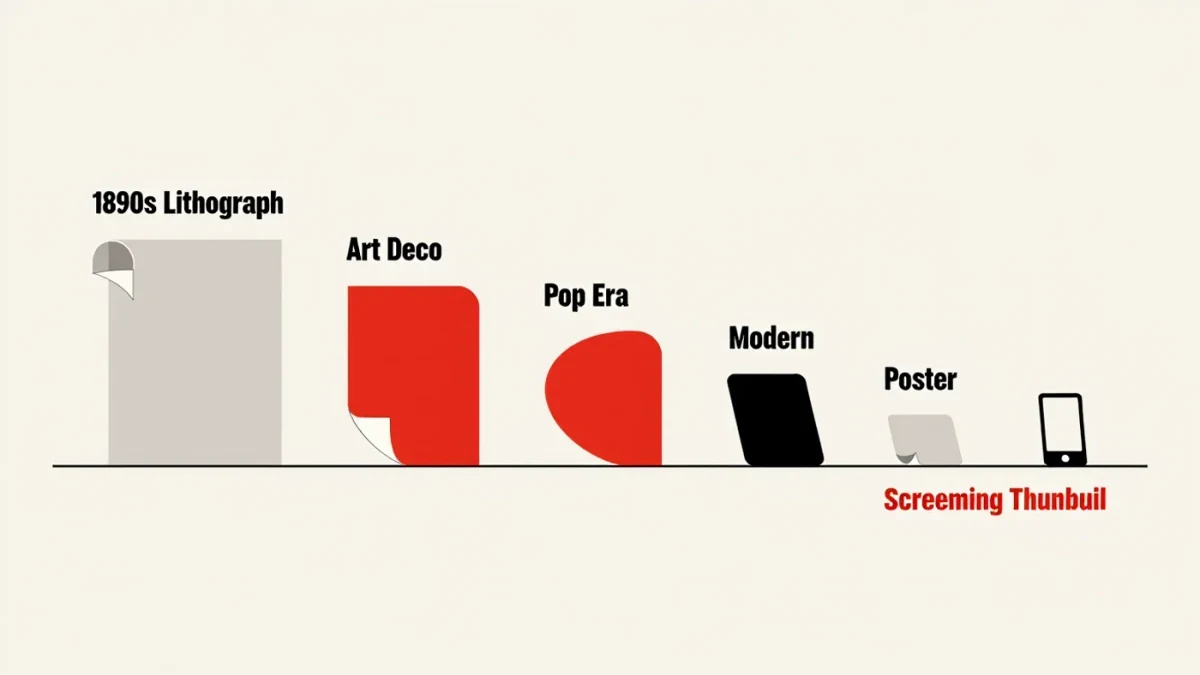
The movie poster began in the 1890s as a hand-printed announcement for a novelty and became, over 130 years, the central object of film marketing — now shrinking from 41-by-81-inch billboards into thumbnail-sized streaming artwork. The Library of Congress preserves thousands of these sheets in its poster collections, and their sequence tells the history of both graphic design and the film business. Here is that history in five eras.
What came before the movie poster?
The format was inherited, not invented. In nineteenth-century Paris, the color lithography perfected by Jules Chéret produced enormous advertising posters for cabarets, medicines, and the circus; when the Lumière brothers and Thomas Edison's companies began screening moving pictures in the 1890s, they borrowed the same technique and size. Early film posters from the 1890s and 1900s were typically a single painted image, the film's title, and a claim of marvel — audiences were being sold the medium itself, not any story. These sheets were meant to be pasted up and destroyed, which is why survivors are rare and prized; the Library of Congress and private collections hold much of what remains.
What did the studio-era poster look like?
From the 1910s through the 1950s, Hollywood's studios industrialized the format. Each release got a coordinated set of sizes — the one-sheet, half-sheet, three-sheet, six-sheet, and the 24-sheet that became the billboard — all derived from a single painted design. Illustration was the mode: exaggerated key scenes, star faces rendered heroically, and credit block typography standardized by the Hays era. The great poster artists of this period worked largely uncredited at agencies and studio art departments, painting in gouache and oil. Genre sells were explicit and gorgeous — film noir's chiaroscuro dolls and pistols, Technicolor musicals' saturated stars — and poster art was considered commercial craft, not museum material, a judgment later generations reversed as illustrators' original paintings began fetching fine-art prices.
How did Saul Bass change poster design?
In the 1950s, design thinking arrived. Saul Bass collapsed the painted montage into a single distilled idea: the torn paper spiral for Vertigo (1958), the dismembered body-outline typography for Anatomy of a Murder (1959), the flailing arm for The Man with the Golden Arm (1955). His approach treated the poster as a modernist emblem rather than a scene catalogue, and it coincided with his animated title sequences — one visual language across a film's entire campaign. The Bass influence spread through the 1960s as studios, losing audiences to television, trusted graphic minimalism to sell adult pictures; it remains the reference point every designer cites for the proposition that a poster can be an idea instead of a picture of the movie.
What happened with photography and the blockbuster era?
The 1970s and 1980s moved the poster toward photography and airbrush, driven by the blockbuster economy. Star Wars (1977) is the hinge case: the Style A one-sheet, painted by Charles White and the Hildebrandt brothers under tight deadline, revived full painted spectacle, and its descendants — the painted montage of faces, ship, and logo — became the default template for two decades of adventure marketing. The 1980s added the airbrushed glow and, by the 1990s, the composition now shorthand for studio caution: the floating-head grid, a rows-of-stars arrangement of retouched performer portraits that optimizes recognizability at the cost of everything else. Drew Struzan's hand-painted campaigns for Indiana Jones, Back to the Future, and Star Wars rereleases kept illustration alive at the highest level even as the industry standardized around photographic composites.
What did digital tools and streaming change?
Photoshop ended hand-painting as the commercial norm in the 1990s, and the poster became a digital composite assembled from studio photography. Two further shifts followed. First, the international and teaser-poster market rewarded stark minimalism — the orange-and-blue palette, the single icon, the white-on-black title — as posters competed for attention in feeds rather than on walls. Second, streaming redefined the format entirely: on Netflix and its rivals the key artwork is a thumbnail measured in hundreds of pixels, and platforms openly test multiple artworks per title, selecting the image that earns the most clicks for each viewer segment. A 2026 film's campaign still ships one-sheets for theaters and collectors — Mondo and gallery print runs have turned poster design into a collectible art market — but the poster's primary workplace is now a phone screen. The object survives; the canvas shrank.
Why do old posters matter now?
Because they are the film history that survived. Posters record how each era wanted its films seen — what was exaggerated, who was enlarged, which genre conventions could be invoked with three visual words — and they often outlive the prints and even the films themselves; poster evidence has helped reconstruct the release histories of lost silent cinema. For collectors, the market spans a few dollars for modern reprints to hundreds of thousands for pre-war originals at auction. For everyone else, the history is simply legible in any poster you pass: painted marvel, modernist emblem, photographic composite, or algorithm-tested thumbnail, each one a dated decision about how to make you look.