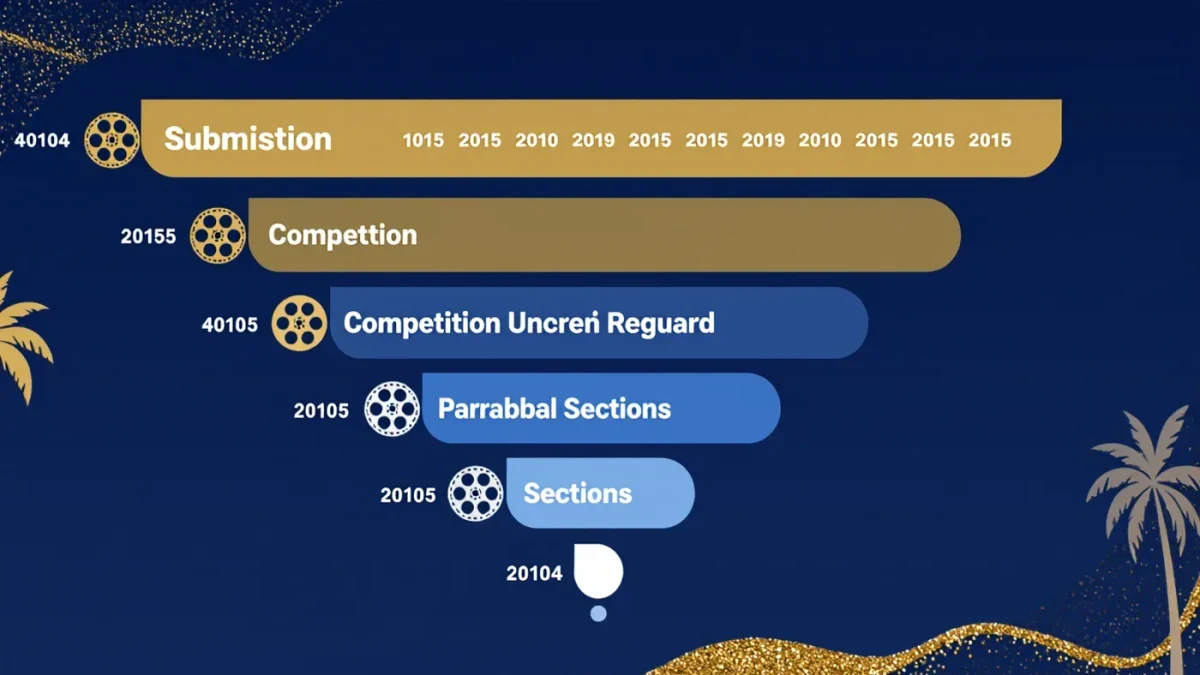
Cannes builds its lineup through a months-long selection process run by the festival's own committee, headed since 2007 by delegate general Thierry Frémaux: filmmakers submit films for consideration, the committee screens them in Paris, and the resulting official selection is announced at a press conference, traditionally held in mid-to-late April ahead of the May festival. For scale, the festival has said in recent years that it considers on the order of two thousand submitted feature films for roughly fifty competition and section slots. The single most important rule: with narrow exceptions, a film must premiere at Cannes — screen publicly nowhere before its festival date — to be eligible for the official selection.
Who decides, and what are they deciding between?
The selection is made by a small permanent team at the festival's Paris offices rather than by jury. Frémaux, who has described the process in on-record interviews and an annual pre-festival press conversation, oversees a committee that watches submissions continuously through winter and early spring. Juries, the celebrities who hand out the Palme d'Or, enter only after selection: they judge the films Cannes already chose. The committee is effectively programming a set of distinct sections, and the craft of selection is as much about placing each film in the right section as about saying yes.
What are the sections of the official selection?
Competition is the headline tier, roughly eighteen to twenty-two films competing for the Palme d'Or. Un Certain Regard runs alongside it as a second competition for newer and more formally adventurous voices, with its own prize list. Out of Competition and Midnight Screenings carry high-profile premieres outside the award race, and Cannes Premières hosts established auteurs not in competition. Short films and the Cinéfondation student section complete the official selection. Two further programs — Directors' Fortnight and Critics' Week — run in parallel during the festival but are organized independently, by the Société des réalisateurs de films and the French critics' union respectively, with their own selection processes and prizes.
Why does the world-premiere rule matter so much?
Because scarcity is Cannes's product. A Cannes premiere is valuable precisely because the film has not played anywhere else, and the festival has historically enforced the rule against major streaming platforms most firmly — the 2017 dispute over Netflix films, which led Cannes to require a French theatrical release for competition titles and Netflix to withdraw its films, was the most public clash over this policy. The rule shapes strategy: studios and sales agents hold finished films out of earlier winter festivals to keep Cannes possible, and a premiere at a rival festival in the first months of a year generally closes the Cannes door for that film.
How does the April announcement actually work?
At the Paris press conference, traditionally in the second half of April, Frémaux and festival president Iris Knobloch read out the official selection film by film, with additions sometimes announced in the following weeks as slots and negotiations settle — the label of additions to follow is routine. The announcement is closely covered because it effectively sets the map of the film year: which auteurs have finished new work, which studio titles will premiere on the Croisette, and which debut filmmakers were plucked from the submission pile. In 2025, for example, the 78th edition ran May 13-24 with a lineup announced at the April press conference, per the festival's official materials.
What happens to films that do not get in?
Rejection is the statistical norm, and the outcomes vary. Some films go to the autumn festival circuit — Venice, Telluride, Toronto — which program from May onward with knowledge of what Cannes passed on. Others enter the parallel Cannes sections if invited, or move directly to distribution. Filmmakers can also be invited back: the festival's relationship with directors is long-term, and Frémaux has said publicly that passing on a film one year does not end the conversation with its maker. For viewers, the announcement each April is worth one practical reading: the list of premieres is a preview of the titles that will fill arthouse theaters and streaming queues through the following awards season.