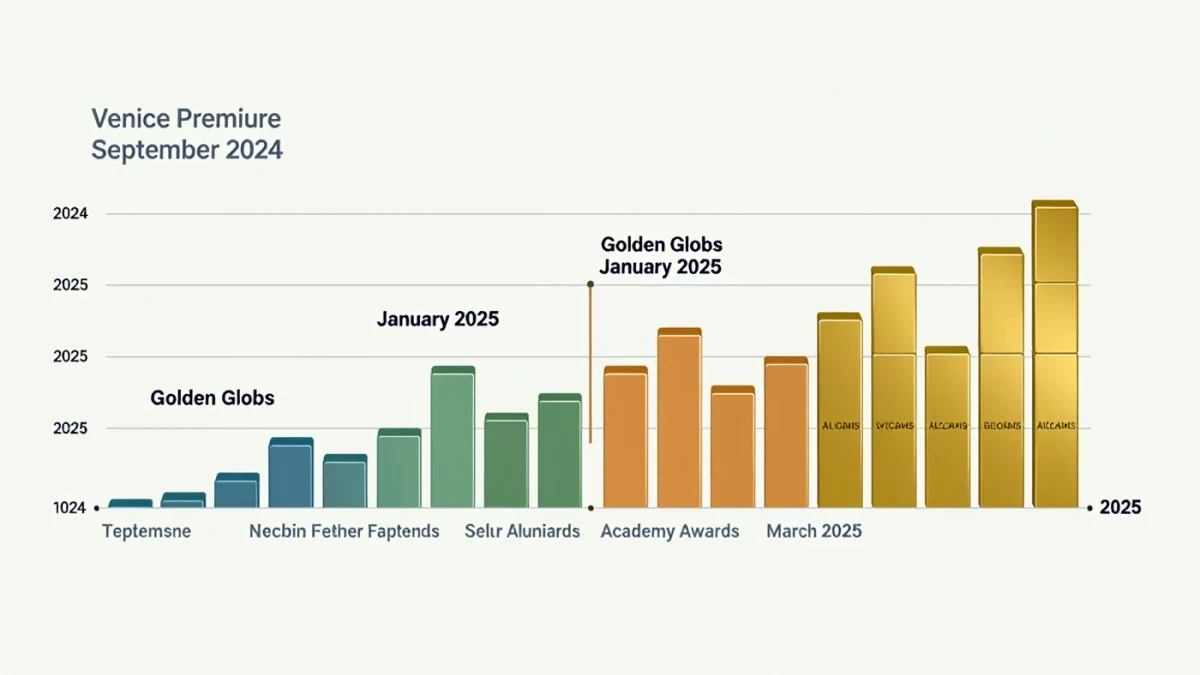
The Brutalist, directed by Brady Corbet and released by A24, is a 215-minute drama about a Hungarian-Jewish architect rebuilding his life in postwar America, and it won three Academy Awards on March 2, 2025: Best Actor for Adrien Brody, Best Original Score, and Best Cinematography. It had taken the Silver Lion for best director at Venice in September 2024. This roundup assembles what named critics and outlets said — the admiration, the reservations, and the post-nominations debates. Reception points below are attributed; Red Orb News offers no verdict of its own.
What Is The Brutalist and Who Made It?
Brady Corbet co-wrote the film with Mona Fastvold and shot it on VistaVision over just 26 days, funded through an independent production with producers including Andrew Lauren; distribution in the U.S. was handled by A24 after its Venice premiere on September 1, 2024. Adrien Brody stars as László Tóth, with Felicity Jones, Guy Pearce, and Joe Alwyn. The film runs 215 minutes including a built-in intermission — a structural choice its critics discussed as much as its story. The premise, kept spoiler-light: a celebrated architect arrives as a refugee and falls under the patronage of a wealthy industrialist.
What Did The Brutalist Win and Get Nominated For?
At the 97th Academy Awards on March 2, 2025, The Brutalist received ten nominations and won three: Best Actor (Adrien Brody, his second, 22 years after The Pianist), Best Original Score for Daniel Blumberg, and Best Cinematography for Lol Crawley. Its losses included Best Picture, Director, and Supporting Actress. Earlier in the season it won Best Drama and Best Director at the Golden Globes on January 5, 2025, and took the top prize at the British Academy Film Awards' directing race in February 2025.
What Did Named Critics Say About The Brutalist?
The critical record was strongly positive on ambition and craft. As of its awards run, the film held a critics' score in the low-to-mid 90s on Rotten Tomatoes, per that aggregator's own page. Recurring praise, drawn from named reviews: reviewers at The Guardian, including Peter Bradshaw, admired its scale and VistaVision photography and ranked it among 2024's standout films; critics at Variety and IndieWire highlighted Brody's lead performance and Lol Crawley's cinematography; and writers at The New York Times and the Los Angeles Times treated it as a serious American epic in an era when few are attempted — positions summarized from their published reviews.
The reservations: several named critics found the film's second half weaker than its first, and its final-act framing contrived. Some reviewers at smaller outlets questioned whether the themes justified the length. The disagreements were about degree, not legitimacy — even the film's detractors treated it as a major work being argued with, per reception compiled across the season.
What Controversies Surfaced During Awards Season?
Two debates, both dated to January 2025 and both part of the film's record. First, editor Dávid Jancsó disclosed in an interview that artificial intelligence tools were used to refine Brody and Jones's Hungarian pronunciation and to adjust elements of the architectural drawings; the film's cinematography nomination debate also touched on whether VistaVision's digital finishing changed its character. Second, Jancsó's and Corbet's statements about the production's minimal budget and the crew's deferred pay drew discussion about independent-film economics. Corbet publicly disputed press framing of the AI use, stating it was limited to pronunciation refinement. These are reported facts about the production, not judgments of the film.
What Is VistaVision and Why Did It Matter Here?
The film's most-discussed technical choice was its camera format. VistaVision is a 1950s American process that runs 35mm film horizontally through the camera, producing a negative twice the standard width — the format of Alfred Hitchcock's Vertigo and North by Northwest. It had been effectively dormant as an original photography format for decades before The Brutalist revived it, and shooting it meant using rebuilt antique cameras and, per the production's own accounts, working around equipment built for another era.
Why bother? The larger negative yields finer grain and supports enormous enlargement — exactly what a film intended for 70mm-style projection scale wants. Critics repeatedly described the images as monumental, and the format is a large part of the reason; Lol Crawley's cinematography subsequently won the Oscar on March 2, 2025, one of the film's three wins.
The intermission is the other structural choice. The film pauses at roughly its midpoint, an old roadshow convention that Corbet retained — and which became part of the reception conversation itself, with some critics treating the break as integral to the film's rhythm and others as an affectation. Either way, home viewers control the pause button, which quietly changes the experience the theatrical version engineered.
Where Can You Watch The Brutalist?
As of January 2026, The Brutalist is available for digital rental and purchase on major platforms in the United States, with subscription availability varying by region and date — availability changes frequently, so check your platform's listing. Dated January 2026.
| Title | Year | Director | Distributor | Runtime | Where to watch (date checked) |
|---|---|---|---|---|---|
| The Brutalist | 2024 | Brady Corbet | A24 | 215 min | Digital rental/purchase on major platforms (Jan. 2026) |