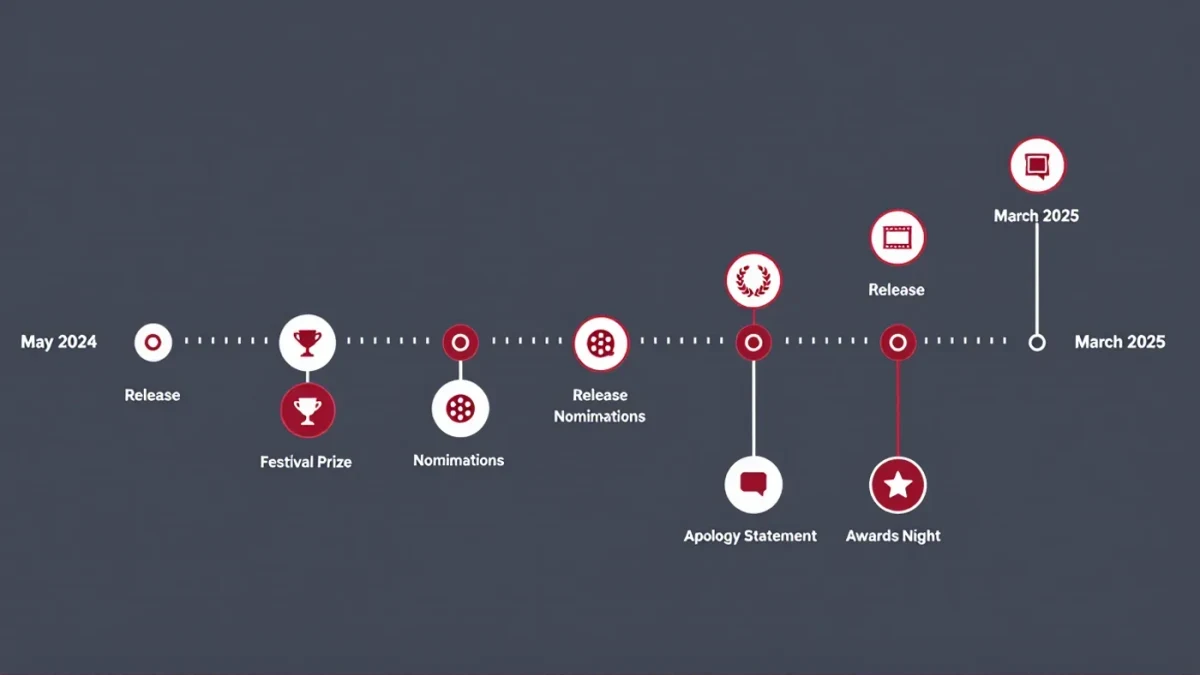
The Substance is a 2024 body-horror film written and directed by French filmmaker Coralie Fargeat, starring Demi Moore as an aging celebrity who takes a black-market serum that generates a younger version of herself, played by Margaret Qualley. It premiered at the Cannes Film Festival in May 2024, where it won Best Screenplay, and went on to five Academy Award nominations, including Best Picture, at the ceremony held March 2, 2025. This guide assembles what named critics and outlets said about it, and what it won, so you can decide whether to watch.
What kind of film is The Substance?
It is Fargeat's second feature after Revenge (2017), a 141-minute French-US co-production released by the independent distributor MUBI in the United States. The film plays in straightforward horror tradition: an industry that discards women past a certain age, a miracle product with conditions attached, and a body that pays the price. Dennis Quaid co-stars as the television producer who forces Moore's character out of her aerobics show. Critics repeatedly placed it in the lineage of David Cronenberg's body horror and of The Fly-style transformation stories, while noting that Fargeat's target is the beauty economy rather than science gone wrong.
What did critics at the major outlets say?
Reception was strongly positive on the whole, with a visible split over its extremity. Critics at The Guardian praised the film's fury and craft, with the paper's five-star Cannes review calling it a ferocious satire of ageism in the entertainment industry. Writers at Variety highlighted Moore's performance as a career-redefining turn and credited Fargeat's controlled, amplified style. Critics at the Los Angeles Times described it as an audacious, squirm-inducing spectacle that earns its grotesque final act. At the more reserved end, reviewers at New York Magazine's Vulture argued the satire was broader than its ambitions, and some BBC Culture commentary treated the gore as punishing to sit through even when admiring the intent. The disagreement was less about quality than about how much a viewer can take: admiration for the filmmaking was close to unanimous, and comfort levels were not.
How did the awards season treat it?
The film's awards run was unusually deep for an explicit horror title. At Cannes in May 2024 it won Best Screenplay. At the Golden Globes in January 2025, Demi Moore won Best Actress in a Musical or Comedy, and the film's monologue about being dismissed in the industry became one of the season's most-covered moments. At the Academy Awards on March 2, 2025, it was nominated for Best Picture, Best Actress for Moore, Best Director and Best Original Screenplay for Fargeat, and Best Makeup and Hairstyling, which it won. Moore lost the acting Oscar to Mikey Madison of Anora. Aggregated scores, named to their aggregators, told the same story as the critics: high marks on Rotten Tomatoes from both certified critics and audiences, in the high 80s and low 90s respectively as of the 2025 awards season.
What did critics say about the two lead performances?
Nearly every major review treated the casting as inseparable from the film's meaning. Critics at Variety and the Los Angeles Times read Demi Moore's willingness to play the humiliation sequences as itself part of the argument: an actor whose own career was shaped by the industry's treatment of women in the 1990s performing that treatment on screen. Moore's Golden Globe acceptance speech in January 2025, in which she described having been told she was a popcorn actress unworthy of recognition, was widely covered and, per awards-season reporting at the BBC and elsewhere, reframed how voters and viewers approached the performance. Margaret Qualley's work as the younger self, Sue, drew praise from critics at The Guardian and at Empire for its uncanny, weaponized physicality; several reviewers noted that the film asks both actors to be seductive advertisement and body-horror canvas at once, and that neither performance blinks. Dennis Quaid's shrimp-eating producer was more divisive: some critics at The Independent found him a broad cartoon of predatory executives, while others at Deadline's awards coverage called the caricature the point.
Why did the film provoke discussion beyond reviews?
The Substance became a case study in how horror circulates now. Clips of the transformation sequences spread widely on social platforms after the September 2024 theatrical release, and MUBI reported the film as the biggest theatrical launch in the company's history, a claim the distributor stated publicly in fall 2024. Makeup designers Stéphanie Guillon, Frédéric Pierre, and Pierre-Olivier Persin gave extensive on-record interviews about the prosthetic work, which the Academy rewarded with the Best Makeup and Hairstyling Oscar. Critics at The Ringer and Vulture also argued about the film's politics: whether a French director's satire of Hollywood ageism said anything new, or said an old thing unusually loudly. Both positions were argued by named writers at the time, and the film's afterlife — a Cannes prize, a Globe, an Oscar, and a permanent place in best-of-2024 lists at The Guardian and Time Out — reflects a reception that ended up bigger than the argument.
Where can you watch The Substance?
In the United States, The Substance streams on the MUBI subscription service, which also handled its theatrical release; availability is subject to change, so check the platform's current catalog. The film carried an R rating for strong gore and language, and critics at multiple outlets advised that the final thirty minutes in particular are extreme. If you read this far, that is the practical point: admire it or endure it, per the named critics above, but go in knowing what kind of film it is.