Flow (2024), the dialogue-free animated feature by Latvian director Gints Zilbalodis, won the Academy Award for Best Animated Feature on March 2, 2025, becoming the first Latvian film to win an Oscar in any category, after taking the Golden Globe for Best Animated Film in January 2025. Made by a small team in the open-source Blender software, it premiered in the Un Certain Regard section at Cannes in May 2024. Critics at major outlets built their reviews around its wordlessness and its singular production story; this article assembles that attributed record only.
Red Orb News publishes information, not verdicts of its own. Reception below is attributed to named outlets and critics as reported publicly; paraphrase is marked as paraphrase.
What Is Flow, and How Was It Made?
The film follows a cat navigating a flooded world aboard a drifting boat shared with other animals, told entirely without dialogue or human characters. Zilbalodis directed, wrote, scored, and animated much of it himself — his second feature after Away (2019), which he also made largely alone and which sold to Netflix. Flow was produced in Latvia and France with support from the Latvian National Film Centre, with a core team that grew to roughly two dozen people, using Blender's open-source 3D tools rather than industry-standard proprietary software. Its reported production budget was a fraction of typical studio animation: coverage in 2025 placed it in the low millions of euros, compared with the hundred-million-plus budgets of major-studio animated releases. Sideshow and Janus Films distributed it in the United States, opening it in November 2024.
What Did Critics Say About the Animation Itself?
Reviewers at The New York Times and the Los Angeles Times described a tactile, painterly world rendered with an independence from studio visual habits — paraphrasing their shared point, the film looks like nothing else in recent animation because it was made outside the systems that produce nearly everything else. Critics at Variety and The Guardian praised the water simulation and light specifically, with several noting that the flood imagery gains force from the small team's focused craft. Writers covering the awards season at these outlets repeatedly framed Flow as evidence that open tools and tiny crews could reach the category's top.
How Did Critics Read the Film's Wordlessness?
As its defining choice. Because no animal speaks, reviewers noted, the film's storytelling is entirely behavioral and visual — movement, sound design, and the animals' shifting dynamics carry the narrative. Critics at The Atlantic and NPR described the experience as unusually immersive for relying on nonverbal cues, and some connected it to the tradition of silent cinema rather than to other animated features. A minority of reviews found the middle section repetitive or the emotional arc elliptical; the record preserves that split rather than averaging it. The sound design, by Gurwal Coïc-Gallas, was singled out in several reviews and was part of the film's awards submissions.
What Was the Awards Run, by Named Body?
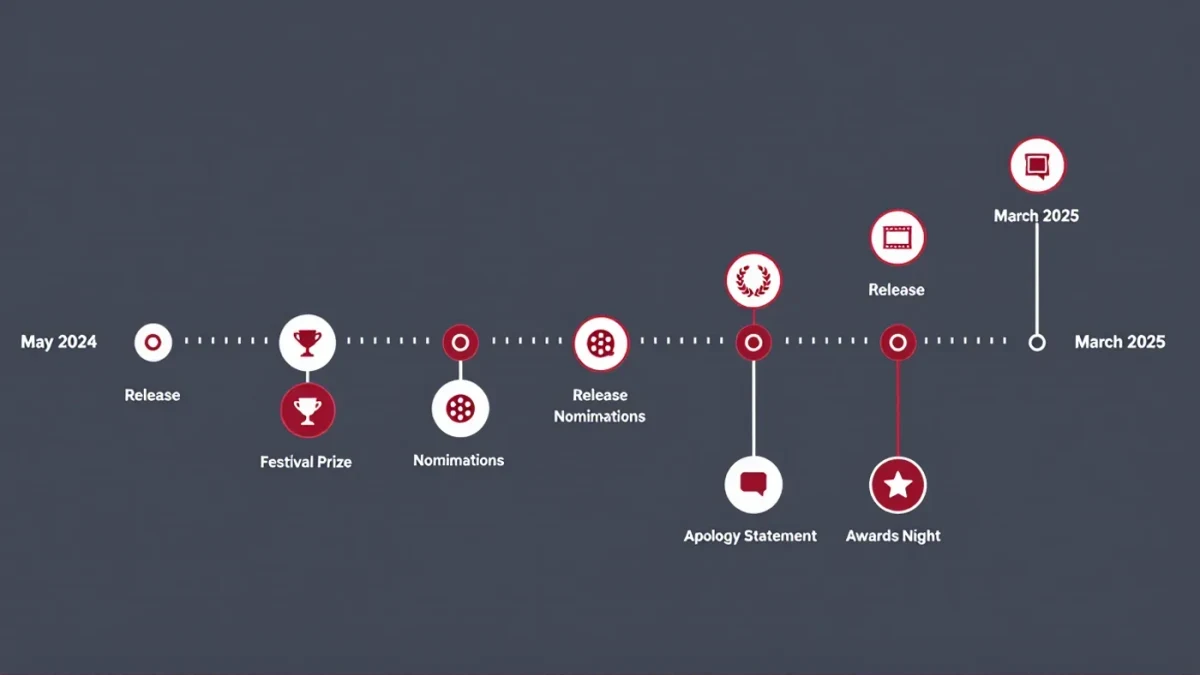
The trail runs from May 2024 to March 2025. Cannes selected it for Un Certain Regard in May 2024. It won Best Independent Animated Feature and Best Direction at the Annie Awards' independent competition in February 2025, the European Film Award for Best Animated Film in December 2024, the Golden Globe for Best Animated Feature on January 5, 2025, and finally the Academy Award for Best Animated Feature on March 2, 2025 — the first win for Latvia and the first fully independent production to take the category in years. It was also Latvia's submission for Best International Feature, reaching that category's shortlist. Aggregates are published by Rotten Tomatoes and Metacritic under their own methodology; this publication quotes no house score.
Why Did the Win Get Called Historic?
For three reported reasons. It was the first Oscar for Latvia in any category. It beat studio entries from major franchises on a budget reported at a small fraction of theirs, which commentators at the ceremony and in the trade press treated as a structural upset. And its path — a Cannes sidebar premiere, a small U.S. distributor in Sideshow and Janus Films, and word-of-mouth expansion — demonstrated a route to the category outside the major studios, a point the filmmakers themselves made in their acceptance remarks on March 2, 2025.
Where Could Viewers Watch It as of mid-2026?
After the U.S. theatrical run that began November 2024, Flow moved to digital rental and purchase in early 2025 and reached subscription streaming during 2025 in several regions, with Max announcing streaming rights in the United States in 2025. Catalog rights shift by territory and date, so the reliable check is the platform's own search on the day you decide to watch. As of June 2026, rental remained broadly available where streaming rights had not taken exclusivity.
What Should Viewers Know Before Watching?
Three things from the record. There is no dialogue, in any language — subtitles are unnecessary. The film depicts animals in peril and flood devastation, which some reviews flagged as intense for younger children despite the animation. And the director's earlier feature Away (2019) streams separately and offers a useful comparison for viewers curious about the filmmaker's development. Nothing above spoils developments beyond the premise.
How Long Is the Film, and What Should Families Know?
Flow runs 85 minutes, shorter than most studio animated features, which several reviewers noted suits its wordless, incident-driven structure. In the United States it carried a PG rating for peril and thematic elements. Because there is no dialogue, the same cut plays identically in every territory, with only localized title cards. For households deciding with children, the cited reviews' consistent note was intensity rather than content: flooding, predator-prey tension among the animals, and sustained uncertainty, without graphic outcomes.