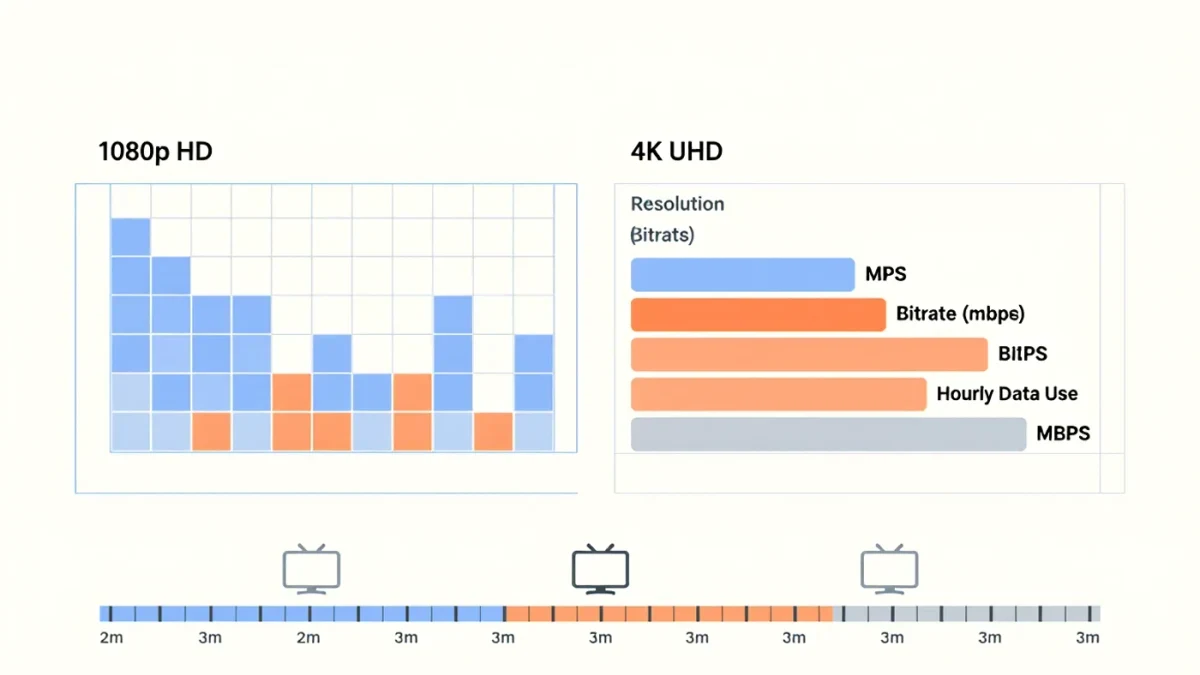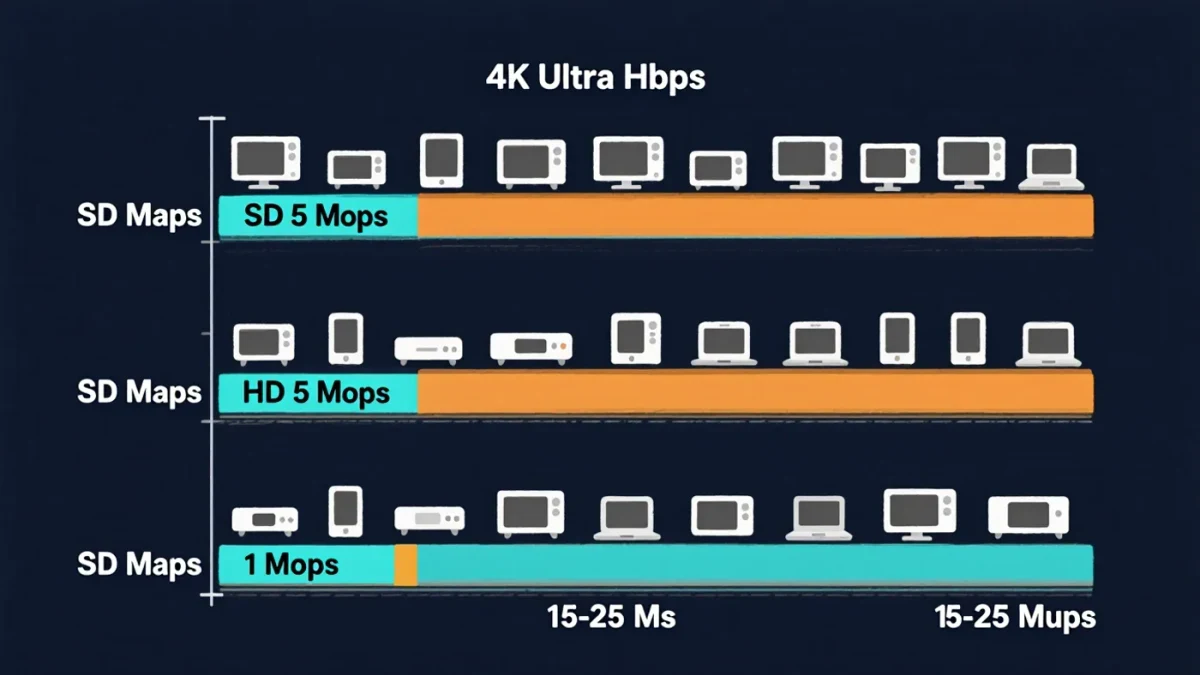
Streaming video needs far less bandwidth than most households pay for: about 1 Mbps for standard definition, 5 Mbps for 1080p HD, and 15 Mbps for 4K Ultra HD per stream, per Netflix's long-published minimums, with Disney+ advising up to 25 Mbps for its 4K titles. As of August 1, 2026, those figures come from each platform's own help pages and change rarely. Two simultaneous 4K streams fit inside a 50 Mbps connection with room to spare.
Red Orb News publishes sourced information, not advice on which internet plan to buy. Platform figures below are dated to their published help pages; treat the provider's current page as controlling.
How Much Speed Does Each Video Quality Level Need?
Video bitrate sets the requirement, and resolution is only a proxy for it. Netflix's published guidance lists approximately 1 Mbps for standard definition, 5 Mbps for high definition at 1080p, and 15 Mbps for 4K Ultra HD. Prime Video publishes the same three tiers at 1, 5, and 15 Mbps; Disney+ recommends 5 Mbps for HD and 25 Mbps for 4K; Hulu's help pages list 8 Mbps for 4K streams on supported plans. These are steady download speeds to the television, not headline plan speeds, and a stream that dips below its threshold does not stop — it drops to a lower resolution, which is why a movie sometimes turns soft mid-scene.
What Do the Major Services Recommend?
| Service | SD | HD (1080p) | 4K (Ultra HD) |
|---|---|---|---|
| Netflix | ~1 Mbps | ~5 Mbps | ~15 Mbps |
| Prime Video | ~1 Mbps | ~5 Mbps | ~15 Mbps |
| Disney+ | — | ~5 Mbps | ~25 Mbps |
| Hulu | — | ~3 Mbps | ~8 Mbps |
| Apple TV+ | — | ~8 Mbps | ~25 Mbps |
Figures as of August 1, 2026, per each platform's published help pages; subject to change. FAST channels and live sports streams typically sit at the HD tier.
Does 4K Streaming Really Need Four Times the Speed?
Not anymore, but the published numbers still skew high because they are worst-case ceilings. Modern encoders — the compression formats services rolled out through the 2020s — deliver a 4K picture at bitrates well under the 25 Mbps older guidance assumed, which is why a 15 Mbps floor is now common. The practical catch is scene complexity: a dim drama compresses easily, while a confetti-heavy live broadcast or a fast-cut sports match spikes the bitrate. If your connection handles films in 4K but a live event stutters, scene complexity, not your plan, is usually the reason.
What Else Eats Your Bandwidth While You Stream?
- Every additional stream in the household claims its own 1–15 Mbps.
- Video calls take roughly 3–5 Mbps up and down.
- Console and PC game downloads can saturate a connection for tens of minutes at a time.
- Cloud backups and photo syncing run quietly in the background on many devices.
- Smart-home cameras upload continuously — small individually, additive together.
A household with two 4K streams, a video call, and a console downloading a game is briefly using more than 100 Mbps. The U.S. Federal Communications Commission's long-standing broadband benchmark of 25 Mbps download was set with single-stream households in mind; per the FCC's own framework, a home of heavy streamers needs a multiple of that.
Does Wi-Fi Change the Equation?
Frequently, yes. The speed that reaches a streaming box is the weakest link in a chain: service plan, router, Wi-Fi band, distance, walls, and finally the device's own receiver. A 300 Mbps plan delivered over a 2015 router on the far side of the house can arrive at the television below 15 Mbps. Wiring the main television to the router with ethernet, or keeping the streamer within close range of a modern router on the 5 GHz or 6 GHz band, removes most mid-film resolution drops. Older devices also cap quality regardless of bandwidth — a television without 4K support cannot display it.
How Do You Test Whether Your Connection Is Enough?
Run a speed test from the device that does the streaming, not from a laptop next to the router, at the hour you usually watch — evening congestion is real on shared cable infrastructure. Compare the result against the table above for the quality tier your plan actually offers: 4K streams, on most services, are locked to top-tier plans, so a mid-tier subscriber testing for 15 Mbps is measuring a stream that will never arrive. If the test reads comfortably above the threshold and the picture still drops, the bottleneck is inside the house — Wi-Fi, an old HDMI cable rated below the tier, or the device itself.
Is Faster Internet Ever Wasted on Streaming?
Beyond a point, yes. Once every stream in the household holds its highest quality with headroom, additional speed changes channel-switching latency by fractions of a second and nothing else on screen. The tier that matters more than bandwidth is the subscription itself: the difference between ad-supported and premium plans often includes 4K, HDR, and multiple concurrent streams — a quality ceiling no connection speed can lift.