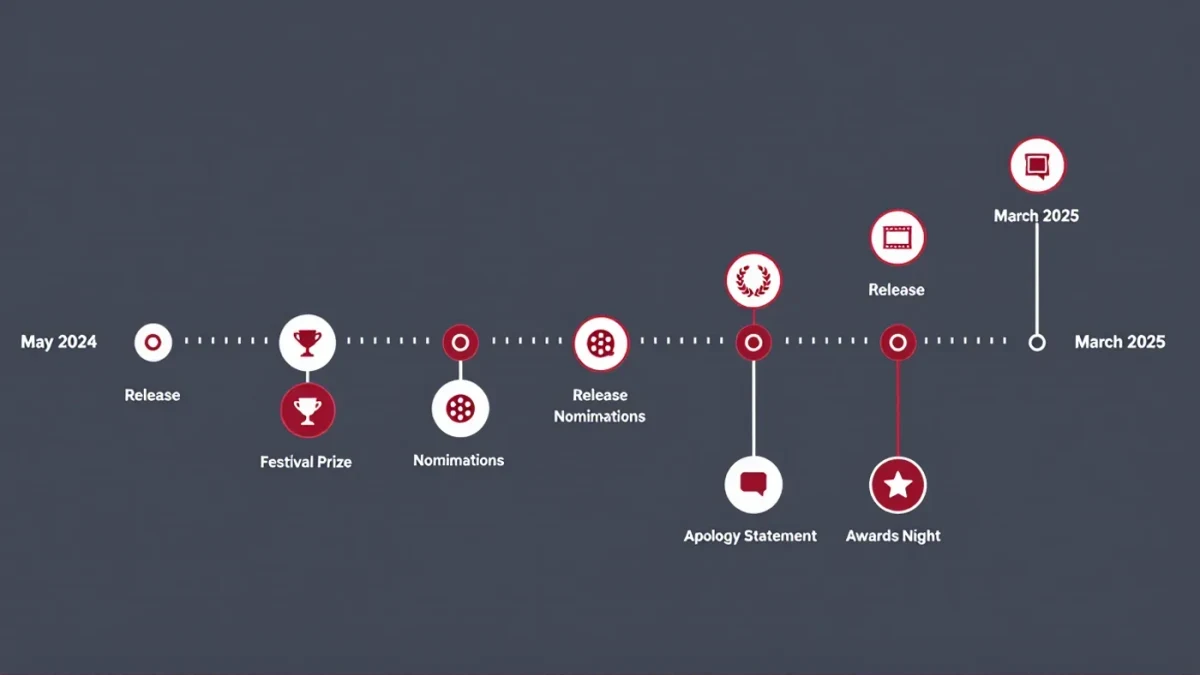
Emilia Pérez is a 2024 Spanish-language musical crime film written and directed by French filmmaker Jacques Audiard, starring Karla Sofía Gascón as a cartel boss who transitions to live as a woman and Zoe Saldaña as the lawyer who arranges her disappearance. It premiered at the Cannes Film Festival in May 2024, where it won the Jury Prize and a Best Actress award shared by its four female leads, and it went on to 13 Academy Award nominations — the most ever received by a non-English-language film — winning three at the March 2, 2025 ceremony. This roundup assembles what named critics and outlets said about the film, and what was said on the record during the disputes that followed.
What did critics say about the film itself?
Critical reception divided sharply, and the coverage never hid the split. Critics at The Guardian awarded the film five stars at Cannes and praised Audiard's audacity in committing fully to a cartel musical. Writers at Variety called it a bold genre hybrid held together by Saldaña's screen presence, and reviewers at the Los Angeles Times similarly highlighted the two lead performances. On the critical side, the New York Times' review described the film's depiction of Mexico as filtered through genre clichés, and several US critics questioned whether the musical numbers served the story. The disagreements were about the film's substance rather than its craft: even the negative reviews generally credited the performances and the scale of the ambition.
How did the awards season treat it?
Emilia Pérez had one of the strongest awards runs ever for a non-English-language film. After Cannes, it was released on Netflix and became France's submission for Best International Feature, which it won at the March 2, 2025 ceremony. Its 13 nominations included Best Picture, Best Director and Best Adapted Screenplay for Audiard, and Best Actress for Gascón, the first openly trans actor nominated in an acting category. Saldaña won Best Supporting Actress, and the film also won Best Original Song for El Mal, by Clément Ducol and Camille. Gascón lost the lead-actress Oscar to Mikey Madison of Anora, in a result widely covered as part of the film's late-campaign troubles.
What criticism came from Mexican audiences and writers?
The most sustained objection, argued publicly from the film's release onward, was about representation: a story set in Mexico, made by a French director working in French studios, with a largely non-Mexican lead cast. Critics at Mexican outlets and US-based Latino writers, including pieces collected by the Los Angeles Times and NPR's Code Switch in late 2024 and early 2025, argued the film reduced the country's drug war to scenic backdrop and treated Mexican Spanish and Mexican lives with inattention to detail. Director Jacques Audiard addressed the criticism in on-record interviews during the campaign, saying he had approached the story as an opera rather than a documentary. Viewers who weigh this criticism can find it fully argued in the named pieces above; the film's supporters, also on the record at Cannes press events, counter that fable and artifice were the point.
What happened with Karla Sofía Gascón's posts?
In late January 2025, after the Oscar nominations, years-old social media posts by Gascón resurfaced — posts mocking Islam, George Floyd's death, and diversity at the Oscars, first surfaced and reported by the trade press. Gascón apologized on the record in an Instagram statement on January 30, 2025, and gave a subsequent interview in which she disputed parts of how the episode was framed; Netflix and the film's campaign kept its distance from her for the remainder of voting, per contemporaneous reporting at Reuters, the BBC, and the AP, and she did not attend the BAFTAs, where the film won two awards on February 16, 2025. She attended the Oscar ceremony on March 2. This article covers her public professional conduct only, as it was reported on the record.
What did trans writers say about the film's portrayal?
Reception among trans commentators was itself split, and the argument was carried out publicly. Some trans writers praised the casting of Gascón, a trans woman, in a lead role of this scale; GLAAD, the LGBTQ media advocacy organization, was critical of the film's depiction of transition, stating publicly in January 2025 that the film's depiction of a trans person was out of step with how trans people describe their lives. Other commentary, including essays at mainstream outlets in early 2025, defended the film's fable-like treatment. As with the Mexico criticism, the positions are on the record under named bylines, and viewers can weigh them directly.
Where can you watch Emilia Pérez?
Emilia Pérez streams on Netflix worldwide, which released it on the platform in November 2024 after a limited theatrical run; it carried an R rating in the United States. Availability is subject to change, so check the platform's current catalog. The practical summary: an unusually awarded film whose reception record — prizes, divided critics, and two documented public controversies — is part of what knowing the title now means.