Searching "film developing near me" usually turns up two kinds of places: one-hour drugstore counters that mail rolls to a central plant, and independent labs that develop in-house. The right choice depends on what you shot, how fast you need it, and how much you care about who actually touches your negatives. A lab that develops on-site gives you control; a mail-in counter gives you convenience.
The most important qualification comes first: ask whether the lab develops in-house or ships your film elsewhere. A counter that forwards your roll adds days, removes accountability, and means nobody you spoke to handled the film. Everything else — price, scans, push processing — matters less than knowing where your negatives physically sit overnight. For related coverage, see How Film Cinematography Works: What Directors of Photography Actually Do.
Photography has been a chemical process since its invention in 1839, and despite the digital shift, shooting motion-picture-style and still film remains a living craft; Wikipedia's overview of film traces how photographic emulsions evolved from long-exposure plates into a medium capable of recording the world in motion. That chemical chain — exposure, development, fixing, washing — is exactly what a lab either respects or rushes. This guide walks through how to judge one before you trust it with a roll.
What should you check before handing over a roll?
Start with three questions, asked in person or by email. Do you develop in-house? What is your standard turnaround for C-41 color negative? And do you handle black-and-white by hand or in a machine? The answers tell you more than any website.
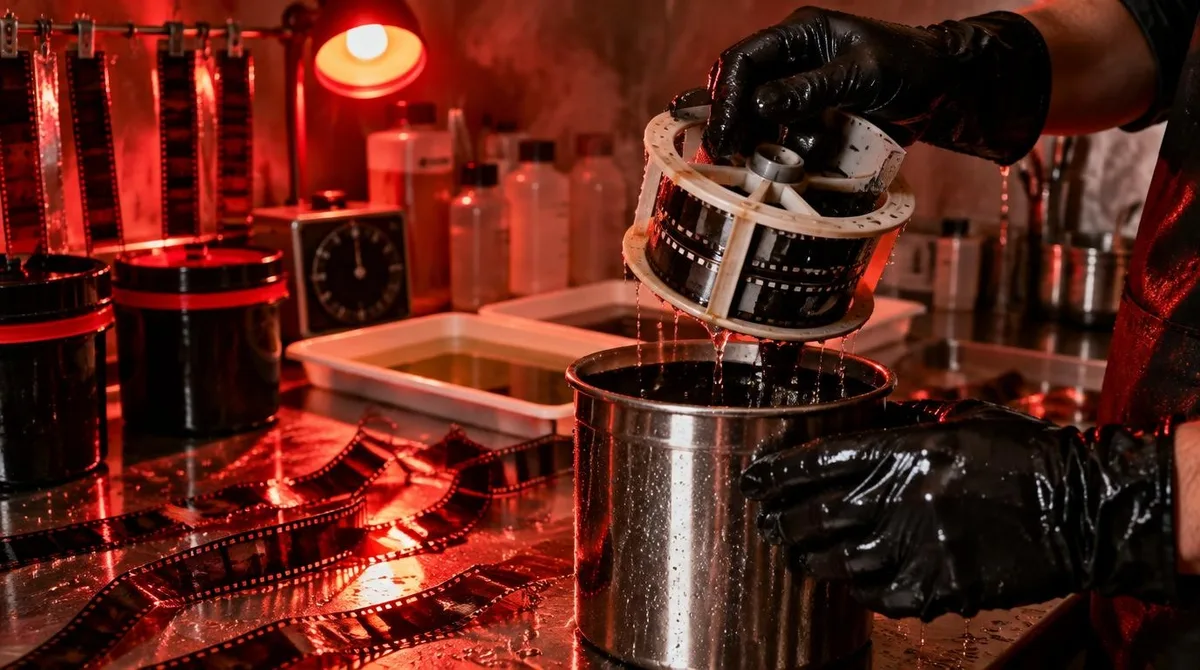
An in-house lab can usually tell you the same day whether a roll came out. A mail-in counter cannot. Hand-developed black-and-white signals a lab with working photographers on staff, because hand development in tanks or a spiral reel demands judgment a dip-and-dunk machine does not. Neither method is wrong, but the difference shows in dust control and in how the lab handles a stuck reel.
Also ask what happens when something goes wrong. A good lab has a written policy for scratched negatives, light leaks from a bad seal, or a development error. A lab that shrugs at that question has told you everything you need to know.
How do price and turnaround actually compare?
Price differences between labs are real but usually modest, and they track service level more than quality. Develop-only costs the least. Develop-and-scan costs more, and the scan resolution — often described in megapixels or file dimensions — drives the gap. Develop, scan, and print costs the most. Ask what each tier includes before comparing numbers, because a cheap develop-and-scan at low resolution is not the same product as a full-resolution scan.
Turnaround splits the market cleanly. Same-day or next-day service usually means in-house development and a machine scanner. Multi-day waits are normal at busy independent labs, especially for hand-processed black-and-white, which often needs dedicated tank time. If you shoot for an event or a deadline, ask for the current posted turnaround, not a historical promise — labs publish typical times, and actual times move with volume.
A practical comparison looks like this:
- Drugstore or big-box counter: lowest price, mail-in turnaround measured in days to weeks, standard scans, limited control.
- Independent in-house lab: mid-range price, same-day to several-day turnaround, scan quality options, staff who can answer questions about your negatives.
- Specialist or pro lab: highest price, handles unusual formats and cross-processing, offers push processing and drum or high-end scanning.
What this means: pay for the service tier you need, not the one that sounds best. A snapshot roll does not need a pro lab. A once-in-a-year shoot might.
Why does push processing depend on the lab?
Push processing means developing film longer than its box speed calls for, to compensate for shooting it at a higher sensitivity in low light. It is a deliberate underexposure recovered in the chemistry. Done well, it lifts shadows with acceptable grain. Done carelessly, it produces flat contrast and muddy highlights that no scan can fix.
Not every lab pushes, and labs that do push differ in discipline. The marks of a lab that takes it seriously: they ask what speed you shot the film at, they log it against your roll, and they can tell you which film stocks they push regularly and to what maximum. A counter that says "sure, we push" without asking your rating has not pushed your film — it has just developed it normally and let you find out later.
Push quality is also stock-specific. Some black-and-white emulsions push gracefully; others do not. A lab that shoots and develops its own work can usually tell you which is which from experience. A lab that only processes cannot. If push processing is central to how you shoot, this single question should decide where you go.
What about scans, negatives, and your files?
Two details separate careless labs from careful ones. First: do you get your negatives back, cut and sleeved, with frame numbers visible? Some cheap services destroy or discard negatives after scanning. Never accept that. The negative is the original; the scan is a copy of it.
Second: how are scans delivered and named? A lab that delivers ordered, frame-numbered files saves you hours of sorting. A lab that dumps a folder of unnamed images treats scanning as an afterthought. Ask about file format too — JPEG is fine for sharing, but TIFF or a high-bit-depth option preserves more of what the negative holds.
Dust and scratches on scans are the most common complaint at any lab, and the fix is mostly a function of scanner type and handling care. Digital dust removal exists on many scanners, but it can soften fine grain. If you shoot black-and-white, ask how the lab handles it, because some dust-removal systems work poorly on silver-based images.
How do you test a new lab without risking a roll?
Practical steps, in order:
- Send a roll you do not care about. Expired film from a drawer works fine.
- Order the full service you would normally use — develop, scan at your usual resolution, negatives returned.
- Check the basics: were the negatives cut cleanly, sleeved, and frame-numbered? Are the scans ordered and dust-free?
- Time it. Note the drop-off date and the delivery date against the lab's posted turnaround.
- Ask one hard question during the visit — about push processing or a scratch policy — and judge the answer.
One test roll costs little and tells you more than a dozen online reviews. Reviews still help, but read them for patterns: repeated complaints about lost rolls or scratched negatives outweigh a single glowing write-up.
If you are new to shooting film entirely, pairing a lab choice with the right camera matters too — our guide to film cameras for beginners covers what to buy first, and our film section collects more on the craft. This connects to our earlier piece, Film Cameras for Beginners: What to Buy First.
The takeaway: match the lab to the shoot
The evidence here is straightforward. Convenience and control pull in opposite directions, and no lab maximizes both. For everyday snapshots, a cheap mail-in counter with standard scans is a reasonable trade. For low-light work that needs pushing, for black-and-white you want hand-processed, or for any roll whose negatives you cannot replace, an in-house independent lab earns its price. Ask the three questions — in-house, turnaround, error policy — and run one test roll before you commit. The lab you keep is the one whose answers you liked and whose negatives came back clean.